
Closing the Year: Building the Foundations for What Comes Next

As the year draws to a close, we wanted to take a moment to reflect on what this year has been about for MicroDAO, what we’ve learned, what we’ve built, and how our thinking has evolved as we work toward a more resilient response to antimicrobial resistance (AMR).
This has not been a year of loud launches. It’s been a year of laying foundations.
We’ve spent time listening to researchers, public health practitioners, policy thinkers, and builders across Web2 and Web3. Again and again, the same pattern emerged: AMR is not short on effort or intelligence, it is short on systems that connect evidence, insight, and funding in a durable way.
That insight has shaped everything we’ve done this year.
Why We Started with Evidence
One of the clearest lessons from this year is that meaningful progress on AMR requires starting upstream.
Before new incentives, new funding mechanisms, or new coordination models can work, the underlying evidence needs to be accessible, structured, and reusable. Today, critical AMR data is fragmented across papers, dashboards, proprietary databases, and ad hoc spreadsheets. The result is duplication of effort, slow decision-making, and lost institutional memory.
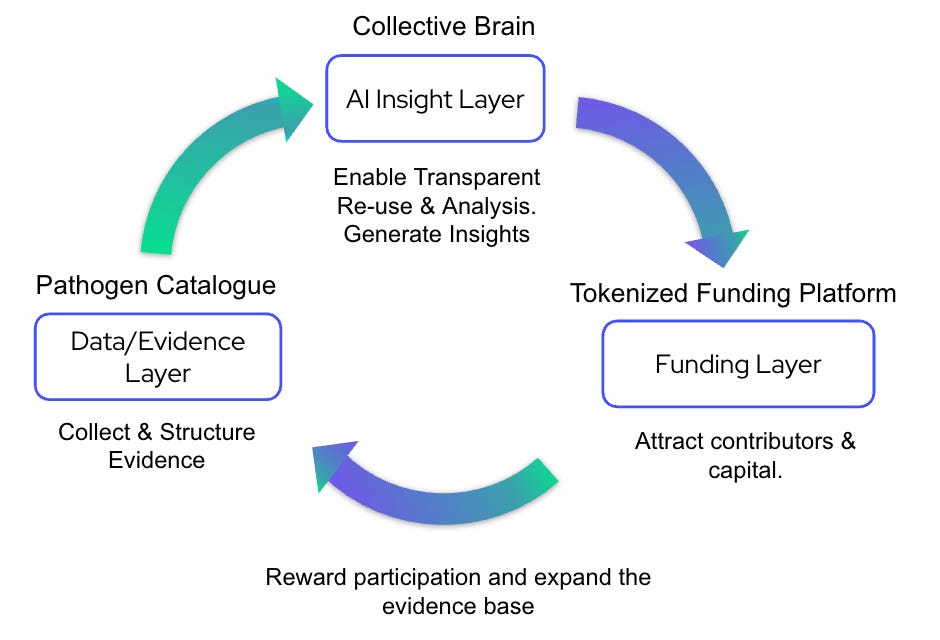
This is why we made an intentional decision to start by building an evidence layer, a foundation that can support better insight, faster collaboration, and eventually, more effective funding models.
This thinking was formalised earlier this year in our developer notes, where we shared why evidence is not just an input to innovation, but infrastructure for it.
What We Built This Year
The Pathogen Catalogue
Formerly known as the Pathogen Solution Marketplace, the Pathogen Catalogue has been one of our core focus areas this year.
The Catalogue is designed to bring together epidemiological context, research signals, and industry-relevant information into a single, structured view of a pathogen. The goal is simple: reduce the time and friction it takes for people working on AMR to understand what we know, where the gaps are, and what matters most.
This year, we are completing the design and development of our earliest release version of the catalogue, and are requesting researchers, public health experts, and industry stakeholders to test the platform and help us shape it for use. Beta sign-ups are open with initial cohorts planned for mid-end of January 2026.
The Insight Layer
Alongside the evidence layer, we continued work on AI powered “collective brain” aka collective research environment designed to support collaborative sense-making.
This platform is not about replacing researchers. It’s about helping them navigate complexity: synthesising literature, exploring hypotheses, and making reasoning more transparent and reusable. Throughout the year, we’ve been building & testing our early version of the platform internally, and have now embarked on a significant revision of the initial build to improve how the agent interacts with data, and stress-testing assumptions about how AI can genuinely support research workflows.
Progress here has been deliberate rather than rushed. Our priority remains usefulness over novelty.
Rethinking Funding and Sustainability
A recurring theme across our conversations this year has been the fragility of AMR funding.
Relying solely on trading fees, speculative mechanisms, or single revenue streams is not sufficient for long-term sustainability in this space. AMR requires continuity. That means building multiple revenue pathways: near-term tools and services that support day-to-day work, alongside longer-term mechanisms that can fund higher-risk, higher-impact research.
This thinking has informed our exploration of tokenised experiments, staged funding, and models that deliberately delink the source of funding from downstream commercial success, a direction we’ll be sharing more about in the year ahead.
Community, Advisors, and Partners
This year has also been about the people around the work.
We’ve been fortunate to welcome new advisors who bring deep experience across public health, research, and systems design, and who have already begun shaping our thinking in meaningful ways. Their guidance has helped us stay honest about what is hard, what is premature, and where MicroDAO can genuinely add value.
We also announced a partnership with FNDR, Bio.xyz, reflecting a shared belief that funding, evidence, and coordination need to be rethought together, not in isolation.
Moments like deSci.Berlin reinforced this further. Spending time with others grappling with similar structural problems reminded us that this is not a solo effort. A broader ecosystem is forming, and MicroDAO is one part of it.
Looking Ahead
As we move into the new year, our focus is clear:
Launch the Pathogen Catalogue to early users and learn quickly from real-world use
Continue refining our AI Insight layer
Advance work on sustainable funding models that support AMR work over the long term
Deepen collaboration with advisors, partners, and the wider community
We are still finding our own balance between independence and the constraints that come with building responsibly, particularly as part of the Bio.xyz ecosystem. That balance matters, and we are committed to navigating it transparently and thoughtfully.
Thank You
To everyone who has engaged with our posts, shared feedback, challenged assumptions, or quietly supported the work this year: thank you.
AMR is a long problem. Solving it will require patience, coordination, and systems that can endure. This year was about putting the first pieces of those systems in place.
We are excited for what the next year holds, and for what we can build together.